HR Placement Agency: The Complete Guide to Recruitment and Staffing Solutions in 2026
- Om sai Group Consultancy
- Jun 19
- 6 min read

Introduction
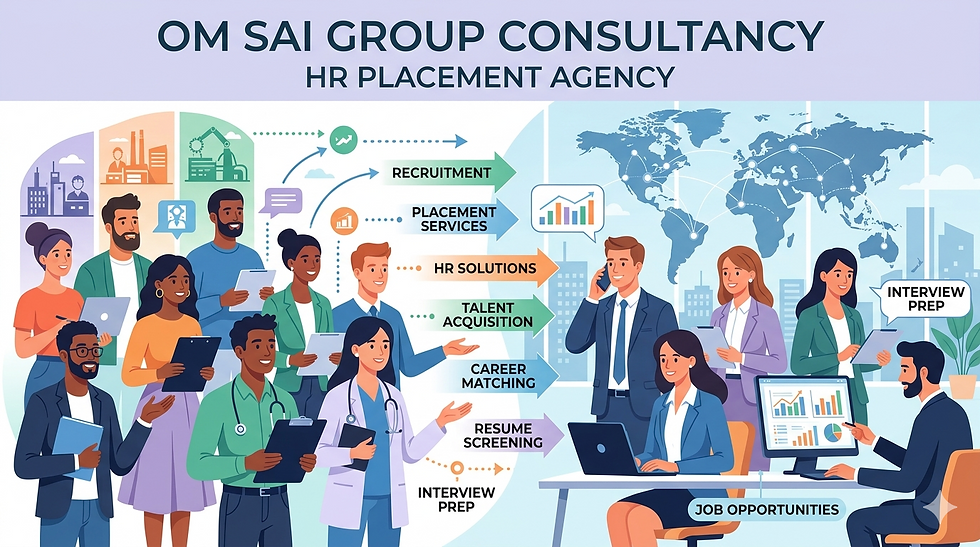
Finding the right employees has become one of the biggest challenges for businesses in today's competitive market. Whether you are a startup, SME, or large enterprise, hiring qualified professionals requires time, expertise, and resources. This is where an HR placement agency becomes an essential partner.
An HR placement agency specializes in connecting employers with qualified candidates for various job roles. These agencies streamline the recruitment process by sourcing, screening, evaluating, and presenting suitable candidates to employers. As businesses continue to face talent shortages and increasing hiring demands, HR placement agencies have become a critical part of modern workforce management.
From permanent recruitment and executive hiring to contract staffing and workforce planning, HR placement agencies help organizations build strong teams while reducing recruitment costs and hiring timelines.
This comprehensive guide explains everything you need to know about HR placement agencies, including their services, benefits, recruitment process, and how they help employers and job seekers succeed.
What Is an HR Placement Agency?
An HR placement agency is a professional recruitment and staffing organization that helps companies hire suitable candidates while assisting job seekers in finding employment opportunities.
These agencies work as a bridge between employers and candidates. Their primary goal is to identify qualified professionals who match specific job requirements and company culture.
An HR placement agency typically manages:
Candidate sourcing
Resume screening
Initial interviews
Skill assessments
Background verification
Salary negotiation
Onboarding support
By outsourcing recruitment activities to an HR placement agency, organizations can focus on business growth while experts handle the hiring process.
Why Businesses Need HR Placement Agencies
Recruitment has become more complex than ever. Companies often struggle with talent shortages, lengthy hiring processes, and high competition for skilled professionals.
Several reasons explain why businesses increasingly rely on HR placement agencies.
Faster Hiring
Recruitment agencies maintain extensive candidate databases and talent networks, enabling them to identify qualified candidates quickly.
This reduces time-to-hire and helps organizations fill critical positions faster.
Access to Better Talent
Many skilled professionals are passive candidates who are not actively searching for jobs. HR placement agencies have access to these candidates through their networks and sourcing channels.
Reduced Recruitment Costs
Hiring internally often involves job advertisements, screening costs, interview management, and HR resources.
Placement agencies help reduce these expenses while improving hiring efficiency.
Industry Expertise
Specialized recruiters understand industry trends, salary benchmarks, and skill requirements, enabling better candidate matching.
Services Offered by an HR Placement Agency
Modern HR placement agencies offer a wide range of services tailored to different business needs.
Permanent Recruitment
Permanent recruitment focuses on hiring full-time employees for long-term positions.
Common roles include:
Software Developers
HR Managers
Accountants
Marketing Specialists
Engineers
Operations Managers
Permanent hiring helps organizations build stable and productive teams.
Contract Staffing
Contract staffing allows businesses to hire professionals for a fixed period or project duration.
Benefits include:
Workforce flexibility
Reduced hiring risk
Lower operational costs
Faster onboarding
Contract staffing is widely used in IT, logistics, manufacturing, and project-based industries.
Executive Search
Executive search services focus on senior leadership positions.
Examples include:
Chief Executive Officer (CEO)
Chief Technology Officer (CTO)
Vice President
Director
General Manager
Executive recruitment requires specialized sourcing strategies and extensive candidate evaluation.
Recruitment Process Outsourcing (RPO)
RPO involves outsourcing the entire recruitment function to an HR placement agency.
This model helps organizations:
Improve hiring efficiency
Scale recruitment operations
Reduce recruitment costs
Access advanced hiring technologies
Many growing businesses use RPO to support large-scale hiring requirements.
Bulk Hiring
Bulk hiring solutions help organizations recruit large numbers of employees within a short period.
Industries frequently using bulk recruitment include:
BPO
Customer Support
Retail
Logistics
Manufacturing
Bulk hiring ensures businesses can quickly meet workforce demands.
Benefits of Working With an HR Placement Agency
Improved Hiring Quality
Recruiters conduct detailed screening, assessments, and evaluations before recommending candidates.
This increases hiring accuracy and reduces bad hires.
Access to Specialized Talent
HR placement agencies maintain networks of professionals across multiple industries and skill sets.
Enhanced Productivity
Internal HR teams can focus on employee engagement, training, and organizational development while recruiters handle talent acquisition.
Better Candidate Experience
Professional recruiters ensure smooth communication, interview coordination, and onboarding support.
Confidential Hiring
Placement agencies can manage sensitive hiring requirements without publicly disclosing recruitment plans.
How HR Placement Agencies Help Job Seekers
While employers benefit significantly, job seekers also gain value from HR placement agencies.
Access to Exclusive Jobs
Many organizations hire exclusively through recruitment agencies.
Resume Optimization
Recruiters help candidates improve resumes and highlight relevant skills.
Career Guidance
Candidates receive advice on career paths, industry trends, and skill development.
Interview Preparation
Recruiters prepare candidates for interviews and employer expectations.
Faster Job Placement
Professional support often reduces job search time significantly.
Industries Served by HR Placement Agencies
HR placement agencies support recruitment across multiple industries.
Information Technology
Popular roles include:
Software Engineers
Full Stack Developers
DevOps Engineers
Cloud Architects
Data Scientists
Healthcare
Healthcare recruitment includes:
Doctors
Nurses
Medical Officers
Healthcare Administrators
Manufacturing
Manufacturing companies hire:
Production Managers
Mechanical Engineers
Plant Supervisors
Quality Controllers
Finance and Banking
Financial institutions recruit:
Accountants
Auditors
Financial Analysts
Investment Specialists
Logistics and Supply Chain
Common positions include:
Warehouse Managers
Logistics Coordinators
Supply Chain Analysts
Fleet Managers
How the HR Placement Process Works
The recruitment process usually follows a structured approach.
Requirement Analysis
The agency first understands the employer's hiring needs, company culture, and job requirements.
Candidate Sourcing
Recruiters search through databases, job portals, professional networks, referrals, and social media platforms.
Screening and Assessment
Candidates are evaluated through interviews, technical assessments, and reference checks.
Shortlisting
Only qualified candidates are presented to employers for further evaluation.
Interview Coordination
The agency schedules interviews and manages communication between candidates and employers.
Offer and Onboarding
Once a candidate is selected, recruiters assist with salary negotiation and onboarding support.
How to Choose the Best HR Placement Agency
Choosing the right recruitment partner is essential for hiring success.
Consider the following factors:
Industry Expertise
Select agencies with experience in your specific industry.
Recruitment Methodology
Understand how candidates are sourced, screened, and evaluated.
Talent Network
A larger candidate database generally leads to better hiring outcomes.
Client Reviews
Check testimonials, case studies, and success stories.
Technology Usage
Modern agencies use AI-powered tools, applicant tracking systems, and analytics to improve recruitment performance.
Common Recruitment Challenges and Solutions
Talent Shortages
Placement agencies leverage extensive networks to identify qualified candidates.
High Competition
Recruiters help businesses attract top talent through targeted hiring strategies.
Skill Gaps
Specialized recruiters focus on finding candidates with relevant certifications and technical expertise.
Hiring Delays
Agencies streamline sourcing and screening to accelerate hiring timelines.
Future of HR Placement Agencies
The recruitment industry is rapidly evolving.
Several trends are shaping the future:
AI-Powered Recruitment
Artificial intelligence is improving candidate matching, screening, and hiring accuracy.
Skills-Based Hiring
Employers increasingly prioritize skills and practical experience over degrees alone.
Remote Workforce Recruitment
Companies are expanding hiring beyond geographical boundaries.
Data-Driven Hiring
Recruitment decisions are becoming more strategic through workforce analytics and predictive hiring models.
Workforce Flexibility
Demand for contract staffing, freelance professionals, and hybrid work arrangements continues to grow.
Conclusion
An HR placement agency plays a crucial role in helping organizations attract, hire, and retain top talent. From permanent recruitment and executive search to contract staffing and workforce planning, these agencies provide expertise that simplifies the hiring process and improves recruitment outcomes.
As businesses face increasing competition for skilled professionals, partnering with a trusted HR placement agency can reduce hiring challenges, improve candidate quality, and support long-term business growth.
For job seekers, HR placement agencies offer career guidance, access to exclusive opportunities, and faster job placement. As recruitment technology continues to evolve, HR placement agencies will remain essential partners in building successful careers and high-performing organizations.
Frequently Asked Questions
What does an HR placement agency do?
An HR placement agency helps employers hire qualified candidates and assists job seekers in finding suitable employment opportunities.
Why should companies use HR placement agencies?
They reduce hiring time, improve candidate quality, and provide access to larger talent pools.
Do HR placement agencies help with executive hiring?
Yes, many agencies specialize in executive search and leadership recruitment.
Can HR placement agencies provide temporary staff?
Yes, most agencies offer temporary staffing, contract staffing, and project-based hiring solutions.
How do HR placement agencies find candidates?
They use job portals, professional networks, referrals, social media platforms, and internal databases to source talent.


Comments