Construction Temp Agency: Site Labour, Safety and Contracts

Construction Temp Agency: Your Complete Guide to Hiring Site Labour Safely and on Schedule
Construction hiring has a rhythm that office hiring does not. In week two, you need excavation crews. By week ten, you need bar benders and shuttering carpenters. By week thirty, the masons are replaced by electricians, plumbers and finishing teams, and the site needs fewer people but better ones. Hire all of them permanently and you pay for idle hands. Hire them in a rush and you get workers who have never seen your kind of project. That is why many builders look for a construction temp agency.
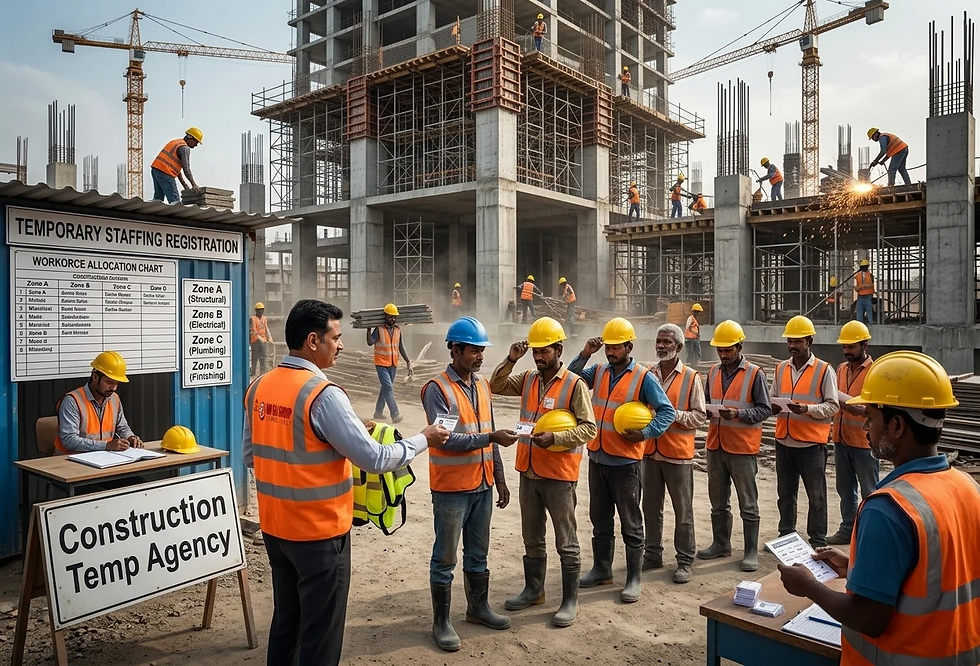
A homebuilder in Pune, an infrastructure contractor in Hyderabad, an interior fit-out firm in Mumbai and a warehouse developer in Delhi NCR may all use one, and the ones who avoid trouble ask hard questions before the first worker arrives.
This guide is a starting point. It explains what a construction temp agency does, how to match workers to project phases, how to check safety and paperwork, and what to agree in writing, so your site runs on skilled people and clear terms.
If you only remember one thing from this page, make it this: on a construction site, the cheapest labour is the one that is trained, documented and clear about who is responsible for what.
First, Understand What a Construction Temp Agency Does
A construction temp agency supplies workers to construction employers for a period, a phase or a project. In most arrangements, the workers are employed by the agency, which pays wages and handles related paperwork, while the site team directs the day-to-day work. The client pays the agency a service charge on top of wages. The roles can include helpers, masons, carpenters, bar benders, welders, electricians, plumbers, painters, machine operators, supervisors, site assistants and sometimes safety staff. Genuine agencies are paid by the client, and workers should never be asked to pay to get a job.
Find Your Situation
If you are a homebuilder or developer Plan labour by phase: foundation, structure, masonry, services and finishing. Ask the agency to supply the right trades at the right time, and to replace people who are not working out.
If you are an infrastructure or civil contractor Ask about machine operators, heavy-work experience and shift patterns. Share the site location, working conditions and safety requirements in writing.
If you do interiors or fit-outs Skilled finishing trades matter more than numbers. Ask how the agency tests carpentry, electrical, plumbing, painting and false-ceiling skills.
If you are a small contractor Start with a small, well-defined crew and learn how the agency handles attendance, payments and replacements before scaling up.
If you run a renovation or repair business Short assignments are common. Ask how quickly the agency can supply trained workers and how it handles last-minute changes.
If your project spans the monsoon Plan for slower weeks, waterlogged sites and travel disruption. Agree how the agency handles idle days and restarts.
If you need supervisors or site engineers Ask how the agency verifies qualifications and experience, and whether it can supply people comfortable with your drawings, standards and reporting.
If you are a worker looking for site jobs Ask who your employer will be, who pays your wages, where the site is and what the pay and shifts are. Never pay anyone to get a job.
Matching Workers to Project Phases
Mobilisation and groundwork. Helpers, excavation crews, machine operators and a supervisor.
Foundation and structure. Bar benders, shuttering carpenters, masons, welders and concrete teams.
Masonry and enclosure. Masons, plasterers, helpers and scaffolders.
Services. Electricians, plumbers, HVAC and fire-safety fitters.
Finishing. Tilers, painters, carpenters, polishers and false-ceiling teams.
Handover. Cleaning crews, snagging teams and a small group of multi-skilled workers.
Share the plan with the agency early. A phase-by-phase headcount gives you a much better chance of getting the right people on the right day.
Safety and Paperwork: Questions to Ask
Construction is a high-risk activity, so ask these questions before work begins:
Training. What safety training do workers receive, and when?
Protective equipment. Who provides helmets, shoes, gloves, harnesses and other gear, and who checks they are used?
Work at height and machinery. Are workers experienced and, where needed, certified for the tasks they will perform?
Accident handling. What is the process if someone is injured, who pays for treatment and who reports the incident?
Insurance and benefits. What cover applies to the workers, and who arranges it? Ask for proof.
Identity and records. How are identity, address and experience checked, and what records do you receive?
Wages and attendance. How are attendance and wages recorded, and how can you confirm that workers are paid on time?
Accommodation and welfare. Where workers are housed or transported, who is responsible for conditions?
Rules on contract labour, wages, safety and construction worker welfare can apply to both the agency and the principal employer, and they vary by state and arrangement. Ask a qualified professional what applies to your project, and keep your own copies of records.
Principles That Apply to Every Construction Employer
Write a clear brief. Trades, numbers, skill levels, shifts, site location and dates should be agreed before work begins.
Know who employs whom. Be certain about the employer of record and who handles each obligation.
Put safety first. Do not let anyone start work without the required briefing and equipment.
Ask for proof. Registrations, payment records and sample reports are more reliable than promises.
Agree terms in writing. Charges, replacements, idle-day rules, audit rights and exit terms should be on paper.
Review regularly. Check attendance, quality, safety incidents and billing, and raise problems early.
What Is Special About Construction Labour in India
Construction in India relies heavily on skilled and semi-skilled workers who often travel from other states, so language, accommodation and food arrangements matter. Work follows the seasons: the monsoon can slow or stop outdoor activity, and festivals and harvest periods can reduce the number of available workers. Pay may be daily, weekly or monthly depending on the arrangement, and clear records protect both sides. Skill levels vary widely, and trade tests are valuable. Rules on contract labour, wages, safety and worker welfare differ by state and project type, so professional advice matters. An agency that understands these realities will plan buffers instead of explaining absences afterwards.
How to Judge Any Construction Temp Agency
Ask how it is paid, who it has supplied before and how it will keep you updated. Ask to speak to the person who will manage your account. Request an example of a similar project, with client details removed, and what went wrong along the way. Check that it has a real, reachable office, registered business details and clear paperwork. Ask how it tests skills and handles safety training. Notice whether it tells you honestly when a number or date is unrealistic, and whether it explains its terms plainly. An agency that says “that start date is tight, here is what we can do” is usually more reliable than one that agrees to everything.
How Om Sai Group Consultancy Works With Employers and Candidates
At Om Sai Group Consultancy, we bring over 18 years of workforce solutions experience. Since our founding in 2008, we have grown into a trusted name in recruitment across India. We are paid by employers, and our services to job seekers are free of cost.
Our approach includes:
A detailed conversation about your trades, numbers, site locations and timeline before work begins
Pan-India and global manpower supply, so requirements can be met across cities
Verified candidates rather than unscreened resumes
One point of contact from the first call to the joining date
Honest guidance, including when a requirement or a deadline needs adjusting
Clear written terms for employers and candidates, including which model applies to your requirement
Whether you need a small crew or a larger team, our consultants work closely with you to keep the process organised and on schedule.
Final Thoughts
A good construction temp agency helps your site get the right people at the right phase, with safety and paperwork in order. Use this guide to plan by phase, ask the safety and records questions above and agree clear terms before work starts. A clear agreement and honest communication protect your project and the people who build it.
If you are planning to hire site staff, Om Sai Group Consultancy is ready to help. Get in touch today to discuss your requirements.
Frequently Asked Questions (FAQs)
1. What does a construction temp agency do?
It supplies workers to construction employers for a period, phase or project, usually keeping the workers on its own payroll while they work at your site.
2. How should I plan labour across project phases?
Share a phase-by-phase plan with trades, numbers and dates, so the agency can supply the right people at the right time, and agree how people are replaced or released as phases end.
3. Who is responsible for safety on a temp-staffed site?
Responsibilities can apply to both the agency and the principal employer. Agree training, protective equipment, supervision and accident handling in writing, and ask a qualified professional what applies to you.
4. How should I handle the monsoon on a labour contract?
Agree in advance what happens on idle or waterlogged days, how restarts are handled and how attendance and wages are recorded.
5. Should workers pay a temp agency to get a site job?
No. Genuine agencies are paid by employers, so a fee request from a worker is a warning sign.
6. Does Om Sai Group Consultancy charge candidates?
No. Our services to job seekers are free of cost.
7. How long has Om Sai Group Consultancy been in business?
We have been operating since 2008, giving us over 18 years of experience supporting employers and candidates across India.
Comments